
IP Protection Against Water and Solid Object Ingress

The IP rating (Ingress Protection) specifies how well electrical equipment is protected against the ingress of solid objects and liquids. It consists of two digits (for example, IP43) and may include an additional letter describing further characteristics. This system is essential when selecting enclosures, particularly for outdoor installations.
All protection ratings listed below are based on EN 60529, which defines protection against the ingress of solid objects and water, as well as access to hazardous parts. The standard assigns IP codes and describes the tests equipment must pass to establish its rating. This internationally recognised coding system provides a clear way to classify the protection of electrical equipment.
IP0x to IP6x – protection against solid objects
| First digit (x) | Protection against solid objects |
|---|---|
| IP0x | No protection. |
| IP1x | Protected against solid objects larger than 50 mm. |
| IP2x | Protected against solid objects larger than 12 mm. |
| IP3x | Protected against solid objects larger than 2.5 mm. |
| IP4x | Protected against solid objects larger than 1 mm. |
| IP5x | Dust-protected (limited ingress). |
| IP6x | Completely dust-tight. |
IPx0 to IPx9 – protection against water ingress
| Second digit (x) | Protection against water ingress |
|---|---|
| IPx0 | No protection. |
| IPx1 | Protected against vertically falling water drops at 1+0.5 mm per minute. The unit is in its normal operating position and rotates around its vertical axis. Test duration: 10 minutes. |
| IPx2 | Protected against falling water drops at 3+0.5 mm per minute. The unit is tested in four positions, each tilted 15° from its normal operating position. Test duration: 2.5 minutes per position. |
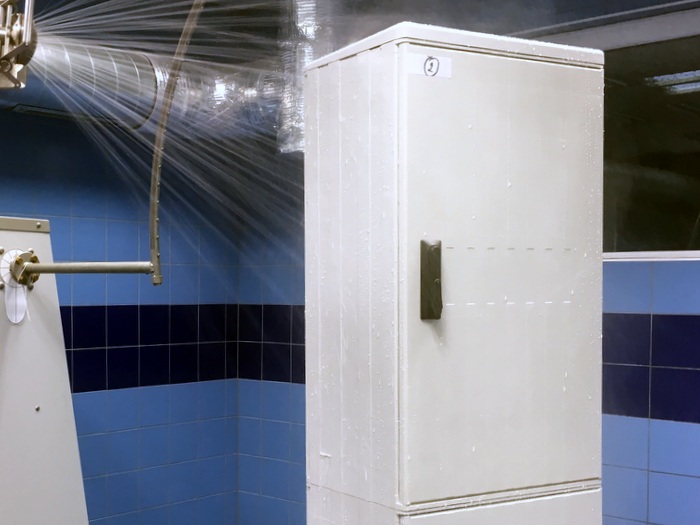
| IPx3 | Protected against water spray. Water is sprayed at the equipment at an angle of up to 60° from the vertical, at 10 litres per minute, for at least 5 minutes. |
| IPx4 | Protected against splashing water. As for IPx3, but water is sprayed from all directions. |
| IPx5 | Protected against water jets. Water is sprayed from a 6.3 mm nozzle from all directions at 12.5 litres per minute for at least 3 minutes from a distance of 3 metres. |
| IPx6 | Protected against powerful water jets. Water is sprayed from a 12.5 mm nozzle from all directions at 100 litres per minute for at least 3 minutes from a distance of 3 metres. |
| IPx7 | Protected against immersion in water for 30 minutes at a depth of 1 metre. |
| IPx8 | Protected against continuous immersion in water. The equipment can remain immersed under conditions specified by its manufacturer. |
| IPx9 | Protected against high-pressure, high-temperature water jets. |
Additional letters
An additional letter after the IPxy designation, such as IP43C, specifies further characteristics. For example:
A – Protected against access with the back of a hand; the test sphere is 50 mm in diameter.
B – Protected against access with a finger; the articulated test finger is 12 mm in diameter and 80 mm long.
C – Protected against access with a tool; the test probe is 2.5 mm in diameter and 100 mm long.
D – Protected against access with a wire; the test probe is 1 mm in diameter and 100 mm long.
Outdoor enclosures – IP43 and IP44
 For outdoor installations, the recommended minimum rating is IP43. What does this mean?
- 4 (first digit): The enclosure is protected against solid objects larger than 1 mm, such as small tools or wires.
- 3 (second digit): Protection against water spray, which is important in rain or in the event of accidental splashing.
For example, metering enclosures installed alongside public roads require an IP44 rating.
- 4 (first digit): Protection against solid objects larger than 1 mm.
- 4 (second digit): Protection against splashing water from all directions.
This rating is suitable for installation near roads, where traffic increases the risk of water spray.
Enclosures for dusty environments – IP54
For more sensitive equipment or installations exposed to dust, a minimum rating of IP54 is recommended:
- 5 (first digit): Dust protection (limited ingress that does not affect operation).
- 4 (second digit): Protection against splashing water.
This rating is suitable, for example, for dusty areas such as construction sites, industrial environments and locations near railway lines.
We also offer enclosures with an IP54 rating. You can find our basic range here.
We can prepare further solutions to suit your requirements – contact us.
Indoor enclosures – IP20
For indoor spaces, an IP20 rating is generally sufficient:
- 2 (first digit): Protection against objects larger than 12 mm (for example, fingers).
- 0 (second digit): No protection against water ingress.
This rating is suitable for areas where there is no risk of contact with water or dust, such as technical rooms, offices and dry workplaces.
Protection and ventilation
When designing an enclosure, bear in mind that a rating such as IP66 cannot be combined with ventilation openings for natural condensation ventilation. High protection ratings such as IP66 require complete sealing against dust and water, which rules out open ventilation holes. Alternative solutions are often used to manage condensation, such as dehumidifiers or special membrane ventilation systems that maintain a high level of protection.
Choosing the right IP rating helps ensure long service life and equipment safety. For outdoor enclosures, we recommend a minimum rating of IP43 and suitable installation conditions.