
Protection and Switching for Public Lighting
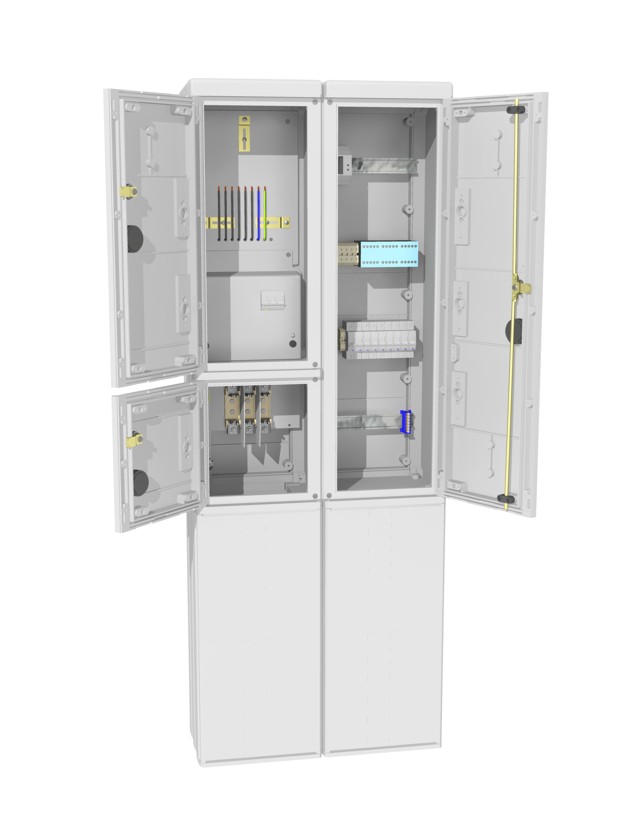
Correct circuit sizing and discrimination are essential for safe, reliable and economical public lighting. This article covers protection coordination, load factors, LED inrush currents and the benefits of switching feeder circuits in sequence.
Correct circuit sizing and suitable protection discrimination are essential for the safe, reliable and economical operation of public lighting. This article summarises key aspects of sizing and protection, including discrimination, load factors, charging and switching currents, and explains the benefits of switching feeder circuits in sequence.
Protection discrimination
Protection discrimination means that, if a fault occurs on a feeder, only the protective device closest to the fault trips. This prevents unaffected feeders from losing their power supply. Discrimination is achieved by using circuit breakers or fuses with suitably graded current and time characteristics. Always base the design on the number and specifications of luminaires connected to each feeder so that the protection is neither undersized nor unnecessarily oversized. Select feeder protection according to the number of luminaires and the parameters specified by their manufacturer. It is also worth optimising the number of feeder circuits with regard to maintenance, fault finding, street layout, luminaire count and protection discrimination.
- Maintain suitable rating steps between circuit breakers (for example, a ratio of 1:1.6 to 1:2 between protection levels).
- Use suitable circuit breaker characteristics (for example, B or C for public lighting, or D for specific applications).
Load factor and total current load
The load factor expresses the actual load on the switchboard compared with the sum of the rated power of all connected luminaires. Public lighting typically has a high load factor (close to 1), because all lights are on at the same time. However, short-term effects such as LED luminaire inrush current and the start-up current of switched-mode power supplies must also be considered.
Recommended practices:
- Allow a 10–20% margin when calculating the load.
- Take actual inrush current values into account, not only the luminaires’ rated currents.
Inrush and switching currents
LED luminaires and electronic ballasts produce brief, high current peaks when switched on. These currents can be up to ten times the rated current. When sizing protection:
- Use circuit breakers with the correct current and time characteristics (for example, type C or D).
- Size the protection to withstand short current peaks without nuisance tripping.
Benefits of switching feeder circuits in sequence
Sequential switching reduces the impact of inrush current by preventing all luminaires from starting at the same time.
Main benefits:
- Lower inrush currents and reduced stress on circuit breakers.
- The option to use circuit breakers with lower current ratings.
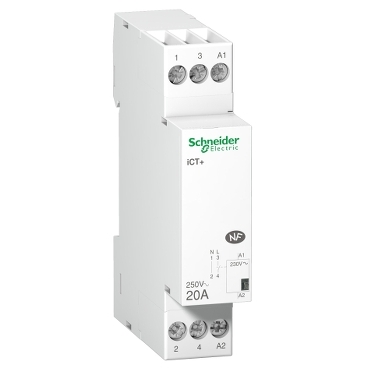 Sequential switching can be implemented, for example, using:
- Time-delay relays.
- Intelligent lighting control systems.
Electronic relays can also switch AC at the zero crossing, significantly reducing charging and switching currents. The drawback is that each phase must be switched separately.
Sizing and discrimination example
If the main breaker in a three-phase, 40 A enclosure, it can work well with six single-phase feeders protected by 20 A breakers (40 A per phase). By contrast, 15 single-phase feeders with 16 A breakers (80 A per phase) cannot be properly protected by a three-phase, 25 A main breaker: the load factor is practically 1, so the main breaker would be undersized. The main breaker rating must therefore be increased, or the current rating or number of feeder breakers reduced. Sequential switching can partly compensate for an undersized main breaker. Reducing the main breaker rating can also significantly lower charges for reserved capacity.
| Main breaker | Number of feeders | Feeder protection | Load per phase (based on feeders) | |
|---|---|---|---|---|
| 40 A | 6 × 1-phase | 20 A | 40 A | OK |
| 25 A | 15 × 1-phase | 16 A | 80 A | X |
| 25 A | 3 × 1-phase | 20 A | 20 A | OK |
| 80 A | 15 × 1-phase | 16 A | 80 A | OK |
Correct sizing and protection discrimination in public lighting switchboards improve operational reliability, reduce operating costs and minimise the risk of lighting outages.
Public lighting is essential to safety and comfort in towns and cities. The way the system is configured affects not only electricity consumption but also maintenance costs and operational reliability. There are several methods for controlling public lighting, each with its own advantages and disadvantages.