
Where Does the Distributor’s Property End? Who Owns the Service Fuse Cabinet?
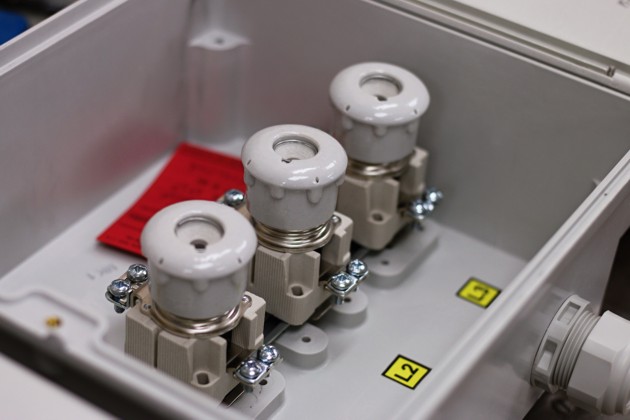
Where does the electricity distributor’s network end and the customer’s property begin? Find out who owns the service fuse cabinet and where responsibility changes hands.
Where does the electricity distributor’s network end and the customer’s property begin? Where is the electricity handover point? Who owns the service fuse cabinet?
Electricity distribution clearly divides responsibility between the electricity distributor and the customer. The key point separating their property is the electricity handover point. It has technical significance as well as legal consequences, since the rights and obligations of both parties depend on it.
What is the handover point?
The handover point is the point at which electricity is physically transferred from the distributor to the customer. Depending on the specific distribution network arrangement, it is usually located at the outgoing terminals of the fuses in the main house service fuse cabinet (HDS). In practice, it marks the boundary between the distributor’s property and the customer’s property and responsibility.
Distributor’s property
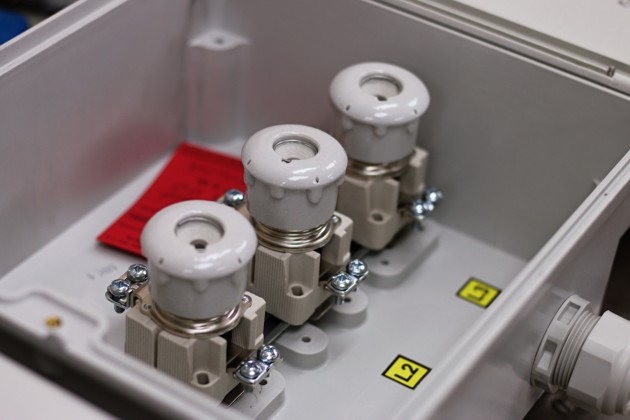 The distribution company owns all equipment up to the handover point, including:
- Overhead lines (wires and cables)
- Transformer substations
- Cable distribution networks
- Main house service fuse cabinets (HDS) or busbars
- The electricity meter and HDO receiver (relay box, smart box, etc.)
All these components form part of the distribution network, which the distributor manages, maintains and modernises. The costs are covered by distribution charges paid by customers as part of their electricity bills. The distributor also installs the service connection cabinet at the supply point.
Customers must not interfere with the distributor’s equipment.
This applies in particular to access, interference, modifications or even replacement of service fuse cabinets (HDS) or fuse links.
Customer’s property
The customer’s property begins beyond the handover point. This is often the cable from the fuses to the meter cabinet, or, in apartment buildings, the rising main. The customer owns and is responsible for the following equipment:
- Main house wiring (HDV) cable from the service fuse cabinet (HDS)
- Electricity meter cabinet
- Internal building wiring
- Internal circuit breakers and fuses
- Appliances and other electrical equipment inside the property
From the handover point onwards, the customer is responsible for maintaining, repairing and ensuring the safety of their electrical equipment. For example, if a fault occurs in the wiring inside a house or apartment, it is the customer’s responsibility, not the distributor’s.
Because the equipment between the handover point and the meter already belongs to the customer, the distributor specifies precise requirements for its installation in the connection requirements. These mainly concern the routing of the main house wiring (HDV) cables and measures to prevent unauthorised interference.
The connection requirements also specify which customer-owned equipment may be installed between the handover point and the meter cabinet. For example, customer-owned fuses may be installed there only to protect a branch circuit from the main house wiring to the meter when that branch is longer than 3 m. Customer-owned fuses upstream of the meter are therefore justifiable only in apartment buildings. However, a distributor’s technician sometimes requires a fuse assembly to be installed beyond the handover point even for a single supply point, for example when a road lies between the handover point and the meter cabinet. In such cases, the connection requirements do not permit the installation of this type of customer-owned equipment (a fuse assembly or cabinet). This raises the question of whether the distributor’s technician can require a fuse cabinet beyond the handover point, especially when the installation already belongs to the customer and the distributor’s rules (connection requirements) do not allow it.
Where exactly is the handover point?
In the Czech Republic, the exact location of the handover point depends on several factors, such as the type of property (house, apartment or commercial premises) and the contractual arrangements between the customer and the distributor.
The handover point is usually located:
- In detached houses: Most often at the outgoing terminals of the fuses in the main house service fuse cabinet (HDS). Today, the house service fuse cabinet is almost always located at the property boundary or close to the house.
- In apartment buildings: Most often at the outgoing terminals of the fuses in a disconnecting cabinet or house service fuse cabinet, or in a cabinet in a plant room or shared area of the building.
- In commercial premises: The handover point may be in the property’s main switch room or transformer substation, including on the high-voltage side.
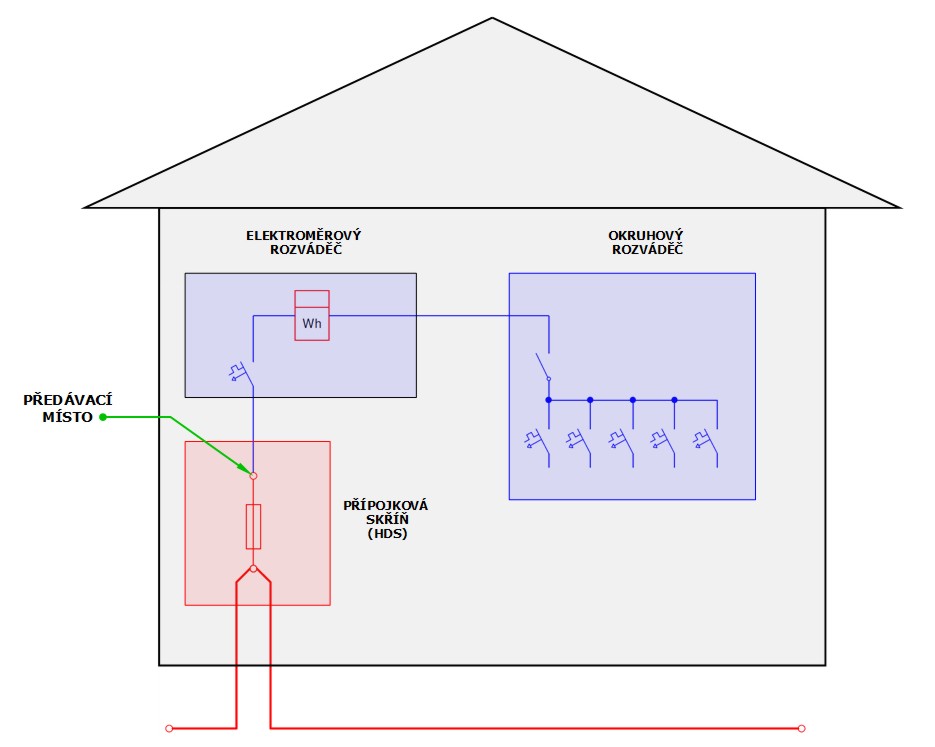
Example of a handover point in a detached house. The distributor’s electrical installation is shown in red and the customer’s in blue.
For new supply points, the distributor usually defines the handover point in its statement concerning the supply point, issued after an application to connect a new supply point. This also defines where the new supply point is to be connected and which installation costs the customer must pay.
Why the handover point matters
The handover point is important for both technical and legal reasons. It marks:
- Measurement of electricity consumption: The electricity meter is located near the handover point. It measures the electricity consumed, and its readings are used to bill the customer.
- Transfer of responsibility: From this point onwards, the customer is responsible for the safe operation and maintenance of the installation.
If a fault occurs or a connection is requested, it is important to know where the handover point is so that responsibility for resolving the issue is clear: does it lie with the distributor or the customer?
The electricity handover point is the key boundary between the distributor’s responsibility and the customer’s. The distributor manages the network up to this point; the customer is responsible for all equipment beyond it. Understanding this boundary matters both for technical reasons and for determining legal responsibility in the event of a fault or defect.