
Which Material Is Best for Outdoor Electrical Enclosures?
Compare the key materials used for outdoor electrical enclosures and learn why ELPLAST-KPZ uses durable SMC composite.
 Electrical enclosures must withstand the elements throughout the year. UV radiation, frost and rain can all cause materials to degrade and become brittle. The material an enclosure is made from is essential to both safety and reliable operation.
Requirements for an outdoor enclosure
- Resistance to rain and moisture
- Resistance to UV radiation
- Weather resistance and dimensional stability
- Surface protection against corrosion and salt solutions (for installations near roads)
- Maintenance-free operation
Examples of outdoor enclosures
 |
 |
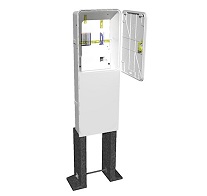 |
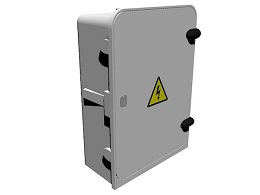
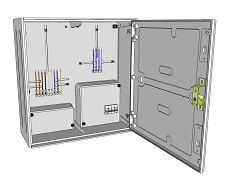
PER PRE/3f/63 recessed or base-mounted (AHVO)Metering enclosure for one single-rate or dual-rate three-phase meter with a main circuit breaker rated up to 63 A. Wired with CY 10 mm2 power conductors. |
PER 2S/3f/40 recessed (Modul)Metering enclosure for one dual-rate three-phase meter with a main circuit breaker rated up to 40 A. Wired with CY 6 mm2 power conductors. The outgoing terminals are outside the sealed compartment. |
PER 2/3f/40 in pillar (AHVO)Metering pillar for one dual-rate three-phase meter with a main circuit breaker rated up to 40 A. Wired with CY 6 mm2 power conductors. |
Outdoor enclosures are made from more than ordinary plastic
Enclosures protect electrical installations from external influences and protect people from potentially fatal contact with electric current. Their materials must therefore withstand wind, rain and sunlight. Outdoor enclosures are made from special-purpose materials, including manganese-aluminium alloys, zinc-protected steel sheet, engineered plastics and composite thermosets.
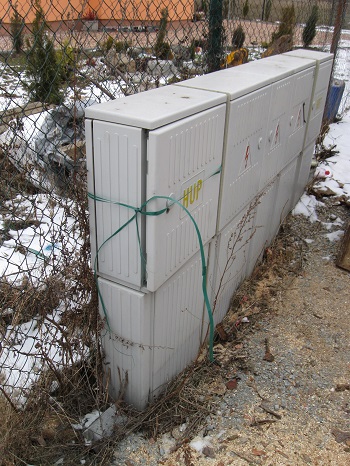
If a metering enclosure is made from poor-quality material, it can degrade, become brittle or warp over time, potentially creating a risk of electric shock.
 |
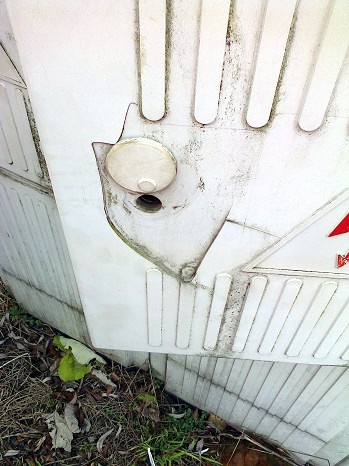 |
| Deformation caused by unsuitable material prevents the cabinet from closing | Enclosure embrittlement caused by material degradation |
Key properties of materials used for outdoor enclosures
Main advantages |
Main disadvantages |
|
Steel sheet |
|
|
Stainless steel sheet |
|
|
Aluminium alloys |
|
|
Concrete |
|
|
Thermoplastic (PC) |
|
|
Composite thermoset (SMC) |
|
|
What is a composite?
A composite is made by combining two or more materials with different properties to create a material with better overall performance. Reinforced concrete and laminate are common examples. Laminate combines resin and glass fibre, making it strong yet flexible. SMC (sheet moulding compound) works in a similar way: glass fibre provides strength, while polyester gives the material rigidity. The result has durable mechanical properties and resists embrittlement caused by UV radiation and frost.
What is a thermoset?
A thermoset, also known as a thermosetting plastic, is cured using heat and pressure. Once cured, it cannot be reshaped or melted. Compared with ordinary plastics, thermosets offer much greater resistance to heat and fire—an important property in electrical equipment, industry and construction.