
How to Choose an Electrical Enclosure
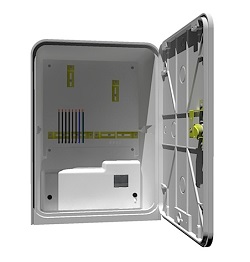
 Choosing an electrical enclosure depends on its purpose, location, number of modules and material. We’ll help you understand the different types and what to look for.
What is an electrical enclosure?
In electrical engineering, an enclosure is a cabinet into which several cables or conductors are routed and which houses electrical devices used to protect, control and measure an electrical installation.
The incoming supply cable and cables from sensors, detectors and various controls enter the cabinet. Cables also leave it to connect other enclosures, individual appliances, socket circuits and lighting circuits.
Basic selection criteria
The first thing to consider when choosing an electrical enclosure is its function. Depending on what you need it for, you can choose a distribution cable enclosure for power distribution networks, a service connection enclosure for connection to the electricity network, a meter enclosure for measuring electricity consumption, a distribution board for electrical circuits in a house, flat or office, or a special-purpose enclosure such as a construction site or portable enclosure. Each type must also meet your specific requirements, such as the number of modules, sufficient space around the DIN rails and the enclosure design.
Enclosure mounting options:
- In a pillar: the enclosure stands in an open area inside a masonry or plastic pillar. The cables run down through the base and into the ground.
- Recessed in a wall: the enclosure is fitted into a recess in the masonry, with cables routed through the building structure, for example under the plaster or inside cavities in plasterboard walls.
- Surface-mounted on a wall: the enclosure is mounted on a wall or structure, with cables run on the surface in trunking, cable trays or conduit.
- On a pole: the enclosure is mounted on an outdoor utility pole, with cables routed through protective conduit.
The material matters!
Ordinary plastics used by some manufacturers can become brittle and crack when exposed to sunlight. Our enclosures are made from SMC thermoset material, which does not suffer from this problem. It is made by the German company Menzolit, and we mould the enclosure components in our own moulds. Our enclosures are highly rigid, impact-resistant and weather-resistant, including against UV radiation.
All our cabinets can also be painted with synthetic, acetone-based, polyurethane or various façade paints.
Distribution cable enclosure
Distribution cable enclosures are designed for distribution networks. Although we can supply them, they are installed only by electricity distribution companies and cable network owners.
Service connection enclosure
Service connection enclosures connect a customer’s premises to the electricity network. The distribution company installs the enclosure, and the network cable owned by the distribution company ends there. The outgoing cables, meter enclosure and any further wiring or equipment are installed by the electricity customer.
Electricity meter enclosure
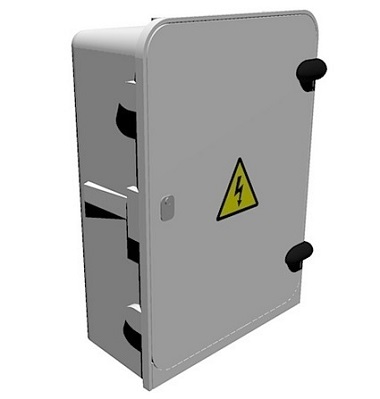 Electricity meter enclosures measure electricity consumption and are designed to meet the requirements specified by electricity distribution companies. Regulations require them to be accessible from a publicly accessible place, for example in a fence at the property boundary or in a shared corridor. This makes it possible to read the meter when the customer is not at home.
A meter enclosure most often contains the main circuit breaker, the electricity distributor’s meter and, where applicable, a ripple-control receiver. The terminal blocks to which the cables are connected are covered and sealed.
An enclosure can be single-rate or dual-rate (for example, if you have a discounted electricity tariff for specific times of day). Its design also depends on where it will be installed, such as recessed under plaster or free-standing in a pillar. Observe the technical specifications too, including the rated current of the main circuit breaker upstream of the meter, in amperes (for example, 25 A or 32 A).
Our electricity meter enclosures are labelled to show which electricity distribution company’s requirements each type meets. You can be confident that they comply with the relevant company’s requirements.
Domestic distribution board
A domestic distribution board houses the devices needed to operate a home or other building. It contains modular devices mounted on DIN rails, especially circuit breakers, residual-current devices, a doorbell transformer, type 1 and type 2 surge protection, time switches for heating control, contactors and relays, and terminal blocks for connecting downstream enclosures and circuits.
When choosing a domestic distribution board, first decide whether you want a recessed version built into the wall or a surface-mounted version fixed to the wall.
You can then choose from a range of distribution boards. Make sure your home’s electrical installation has enough modules and that the board can handle the heat and current loads of the installed devices. Size, appearance, colour and door transparency also matter.
The enclosure’s IP rating is also important. Standard distribution boards are suitable for normal conditions. If the board will be installed in a more demanding environment, choose one with a higher IP rating.
Remember that enclosures are electrical equipment. They may be installed, modified or repaired only by a qualified electrician.