
Public Lighting Control Systems: Advantages and Disadvantages

Compare common ways to control public lighting, including timers, photocells, remote control, astronomical clocks and combined systems.
Public lighting is essential for safety and comfort in towns and cities. Choosing the right control system affects electricity consumption, maintenance costs and operating reliability. Several control methods are available, each with its own advantages and disadvantages.
1) Time switches
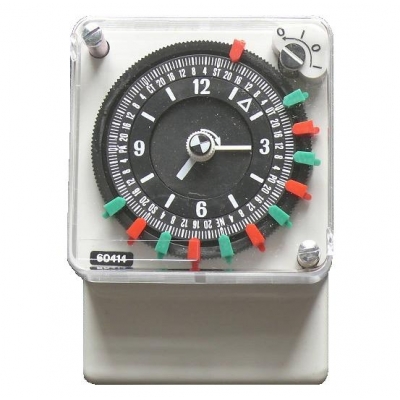 Time switches operate according to preset on and off times. Schedules are set manually and can use different programmes for weekdays, weekends and seasonal changes.
Advantages
- Simple installation and low purchase cost.
- Reliable operation independent of external factors such as weather or network communications.
- Schedules can be tailored to different locations.
Disadvantages
- The time must be adjusted manually when changing between winter and summer time.
- They do not adapt to actual light conditions; for example, lights may come on too late under a heavily overcast sky.
- There is a higher risk of incorrect settings and regular maintenance is required.
2) Twilight sensor
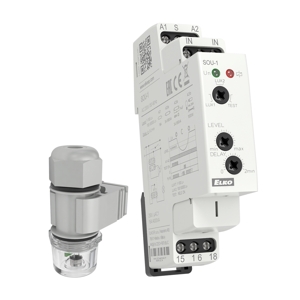 A twilight sensor detects the level of natural light in its surroundings and switches public lighting on when a set threshold is reached.
Advantages
- Automatically adapts to actual light conditions, for example switching lights on earlier under a heavily overcast sky.
- No manual schedule adjustments are needed.
- Simple to implement at a relatively low cost.
Disadvantages
- Local conditions and sensor placement affect accuracy; reflections from streetlights or vehicle headlights may interfere.
- Ageing and wear may cause incorrect switching, such as lights turning on too early or late.
- Brief changes in light, for example from headlights, can cause temporary switching on or off.
3) Sensors operating outside the visible spectrum
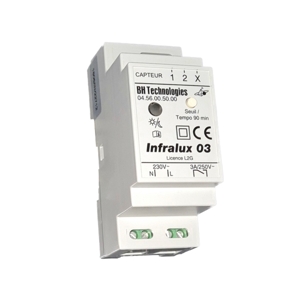 Unlike standard twilight sensors that respond to visible light, these sensors use infrared (IR) or ultraviolet (UV) radiation.
Advantages
- Less interference from other light sources, such as vehicle headlights or lightning flashes.
- More accurate detection of changes in light conditions, especially in fog or heavy drizzle.
- Can be adapted more effectively to specific climate conditions.
Disadvantages
- Higher purchase cost than standard twilight sensors.
- Correct operation requires careful sensor placement; it cannot be installed under direct artificial light.
- Limited market availability and a need for specialist servicing.
4) Ripple control (HDO)
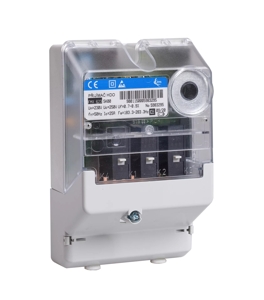 Ripple control (HDO) switches equipment using a signal sent by the distribution company over the electricity network.
Advantages
- Centralised control can switch public lighting across entire areas.
- Little local maintenance is required because the electricity distributor manages the control.
- It automatically adapts to winter and summer time.
Disadvantages
- It depends on the HDO signal provider; a signal failure may affect lighting operation.
- Settings cannot be tailored individually to each location.
- The distributor determines switching times, which may not suit local conditions.
5) Astronomical time switches
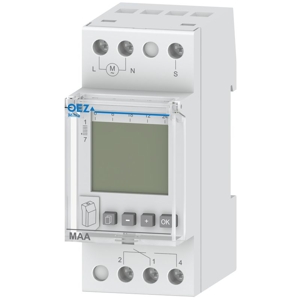 Astronomical clocks switch public lighting according to calculated sunrise and sunset times for a given geographic location.
Advantages
- No external sensor or HDO signal is required.
- Switching times are calculated astronomically.
- They automatically adapt to winter and summer time.
Disadvantages
- They do not adapt to current weather conditions; for example, lights will not come on earlier in dense fog.
- Programming is more complex than for standard time switches.
- They cost more than conventional time switches.
6) Combining control systems
In some cases, the best solution is to combine several control methods. For example, a twilight sensor combined with a time switch provides effective control: the sensor switches lights according to actual light conditions, while the timer can limit operation during quieter hours.
Advantages
- Some public lighting can be switched off during periods of low activity, for example between midnight and 4 a.m.
- Combining the strengths of both systems improves adaptation to actual conditions.
- If one device fails, the other may still provide basic operation.
Disadvantages
- Settings are more complex and the two systems must be coordinated.
Example of practical use
- All-night mode (normal operation): a twilight sensor switches the lights according to actual ambient light levels.
- Part-night mode (overnight energy saving): a time switch turns off selected lighting in quieter areas at night, such as parks, side streets and industrial zones.
This combination is highly effective and often used in towns and cities to reduce electricity consumption without compromising residents’ safety and comfort.
Summary and recommendations
| Control type | Advantages | Disadvantages | Suitable for |
|---|---|---|---|
| Time switches | Simple and inexpensive | Maintenance and manual adjustments required | Small towns and rural areas |
| Twilight sensor | Adapts to light conditions | Sensitive to interfering light sources | Urban areas |
| IR/UV twilight sensor | Resistant to artificial light interference | Higher cost | Industrial zones |
| HDO ripple control | Centralised, low-maintenance control | Depends on the distributor | HDO systems are being phased out |
| Astronomical time switch | Automatic time adjustment | Does not adapt to current weather | Medium and large cities |
| Combined systems | Flexible and efficient | More complex setup | Towns and residential areas |
Choosing a suitable system
- Time switches or twilight sensors are suitable for smaller towns and simpler installations.
- Astronomical clocks provide consistent switching with little maintenance, but do not account for current weather.
- Advanced IR/UV twilight sensors can be useful where interference from artificial light is common.
The best solution depends on local conditions and requirements for reliability and maintenance. Combining technologies, such as an astronomical clock with a twilight sensor, can help reduce the disadvantages of individual methods.