
Electrical Enclosures in Insulated Walls: Fire Safety and Installation
How to install an electricity meter enclosure in an insulated wall safely. Learn about fire reaction classes, replacing or raising an enclosure, and insulation around an existing enclosure.
Installing an electrical enclosure in an insulated wall with a focus on fire safety
Before looking at the details of installing an enclosure in an insulated wall, we need to consider the fire behaviour of the building and insulation materials involved. Masonry, expanded polystyrene and mineral wool each present specific safety considerations that must be taken into account during electrical installation work.
Reaction to fire of building materials
Before installation, it is essential to understand the reaction to fire of the building material in which the enclosure will be installed. Building materials, including masonry, are assigned reaction-to-fire classes under EN 13501-1, Fire classification of construction products and building elements – Part 1: Classification using data from reaction to fire tests. This classification is an important factor when choosing a safe location for an enclosure.
Another important consideration is the reaction to fire of thermal insulation materials, such as polystyrene and mineral wool. Specific rules apply to the safe installation of electrical equipment in these materials. Respect the reaction-to-fire class and follow the applicable standards to ensure a safe installation.
| Property | Reaction-to-fire class | Example material |
| Non-combustible | A1 | ceramics, glass, metal, concrete, mineral-fibre insulation boards |
| Practically non-combustible | A2 | plasterboard, gypsum-fibre board |
| Hardly combustible | B | vinyl flooring, cement-bonded particleboard |
| Combustible | C | phenolic foam insulation board |
| Easily combustible | D | structural timber, wood-based board |
| Highly combustible | E | polyurethane insulation board, expanded polystyrene (including with flame retardants) |
| Extremely combustible | F | materials for which no class has been determined |
Mortar, bricks, blocks—in other words, masonry
Materials such as mortar, bricks and blocks have reaction-to-fire class A1, meaning they are non-combustible. No additional measures are required when installing an enclosure in class A1 materials.
Expanded polystyrene
Polystyrene (EPS) is inherently a combustible material, although it contains flame retardants that slow the spread of fire. EPS is classified as reaction-to-fire class E. When installing electrical equipment, including enclosures, in polystyrene, choose equipment tested and specifically designated by its manufacturer for installation in combustible materials. This designation should appear in the accompanying documentation or as a permanent mark on the product:
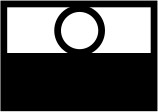 If an enclosure is not intended for installation in combustible materials, a measure is required: line the enclosure with non-combustible, thermally insulating material at least 10 mm thick and with reaction-to-fire class A1.
Fire risk: Because polystyrene is combustible, an enclosure fault presents an increased fire risk. Follow the applicable safety standards and installation rules.
Mineral wool
Mineral, rock or glass wool is naturally non-combustible. If it has reaction-to-fire class A1, no additional measures are required when installing an enclosure.
What should you do with the enclosure?
When planning insulation work, consider whether it would be better to replace the enclosure and any other façade components at the same time. This avoids having to dismantle the new façade in the future.
Common mistakes with an electricity meter enclosure in an insulated façade:
- Leaving an old, non-compliant enclosure in the new façade.
- Recessing the enclosure too far into the wall, restricting access for operation.
- Fitting the enclosure so that its door cannot open far enough, restricting access.
- Removing the original door, leaving the enclosure unable to perform its function safely.
- Installing polystyrene insulation right up to an enclosure that is not designed for installation in combustible material.
Replacing an old enclosure
A common issue is that older houses are insulated and then fitted with a photovoltaic system (PV). In these cases, the existing electricity meter enclosure may no longer meet the distributors’ increased requirements for PV systems, or current standards. If your house still has, for example, a wooden electricity meter enclosure with sheet-metal doors, it is usually essential to replace it before the insulation work. We discuss how to choose a replacement in this article here.
Bringing a suitable existing enclosure forward from the masonry
In some cases, the enclosure can be repaired or modified, or it may already meet all requirements and need no replacement. Before the insulation work, an electrician or inspection technician can help you decide whether it can remain. If it is not obsolete and meets current standards and your future plans, the existing enclosure can be exposed from the masonry and brought forward to the level of the new façade. This is usually the most suitable, practical and technically straightforward option, but it must be done by an electrician. We discuss the required recess depth in this article here.
Keeping a suitable enclosure recessed in the insulation
If the enclosure cannot be brought forward from the masonry, it can remain recessed in the original wall. However, there are important limitations. For safe operation, clear space of at least 800 mm deep and at least 800 mm wide must be available in front of the enclosure. If, for example, the enclosure is 300 mm wide and recessed 200 mm into the insulation, the required 800 mm clear width in front of it is not available. Read more about this here.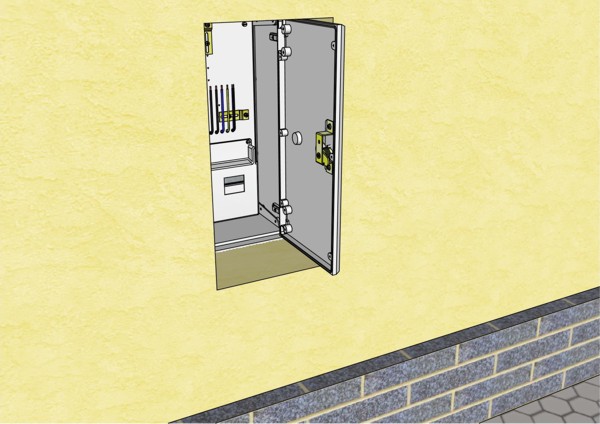
Fitting a new frame and door in front of the enclosure can also cause problems. Even if the frame has the required IP44 or IP43 rating, the existing enclosure must retain its original door to preserve its required properties. The enclosure may only be operated as a complete product. The original door often also carries the product nameplate. It must still be possible to open the original door through the new frame by at least 90°. Our range of frames for insulated façades is available here.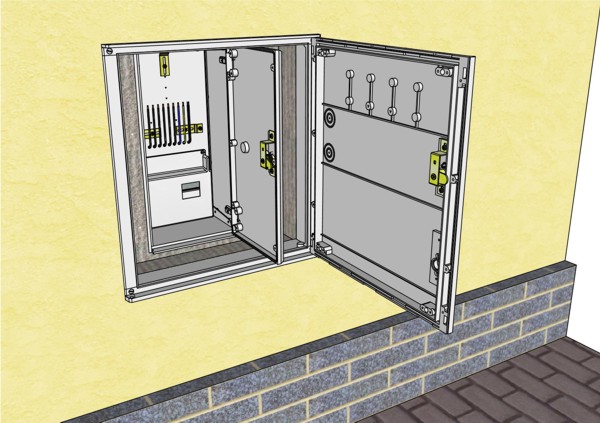
How should the insulation be installed?
Most plastic electricity meter enclosures—and enclosures made from other materials available on the Czech market—have not been tested for installation in combustible materials. This is mainly because the test is demanding and must be performed on each specific enclosure type. Historically, installation in combustible materials was not a requirement because enclosures were almost always installed in masonry, which is reaction-to-fire class A1.
If the wall is insulated with a material other than class A1 (for example, polystyrene) and the enclosure is not designed for combustible materials, protective measures are required. These measures are also required if an existing enclosure cannot be verified as suitable for combustible material and the wall is subsequently insulated with a material other than class A1. In practice, this is often overlooked and existing enclosures are covered directly with combustible insulation.
Creating a gap
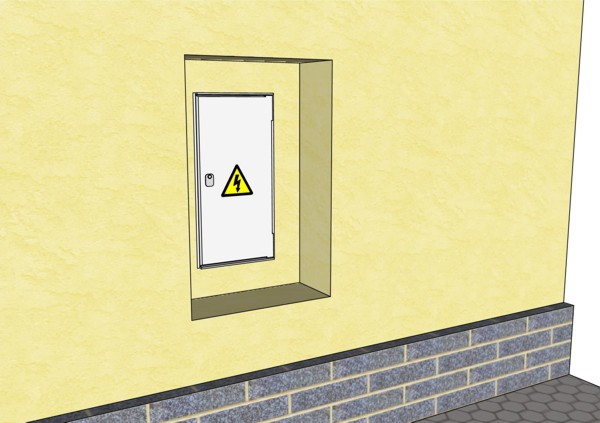
The enclosure can be separated from combustible material by an air gap of at least 50 mm. This is addressed in ČSN 33 2312 ed. 2, Low-voltage electrical installations – Electrical equipment in and on combustible materials. However, leaving part of the façade uninsulated defeats the purpose of insulation, so this is not an ideal solution from an insulation perspective.
Covering with a non-combustible board
The enclosure can also be surrounded by a non-combustible, thermally insulating board at least 10 mm thick and with reaction-to-fire class A1. However, boards are rigid and difficult to fit precisely. The lining must fit tightly around the enclosure and join together without gaps or openings, ensuring at least 10 mm of board separates the enclosure from the combustible material everywhere. The enclosure must also remain securely anchored.
Surrounding the enclosure with mineral wool
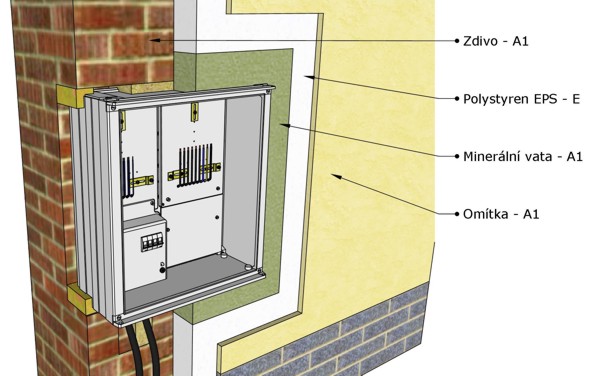
The simplest, safest and insulation-friendly option is to surround the enclosure with a 100 mm-wide strip of mineral wool (reaction-to-fire class A1). This measure meets all safety requirements when insulating with polystyrene, a combustible material, around an enclosure not designed for combustible materials.
Remember:
Safety measures for installing an enclosure in an insulated wall are essential to prevent fires and protect your home. When working with combustible materials, it is particularly important to follow the applicable standards and regulations. A safe installation protects the electrical system and contributes to the overall safety of your home. If you have any doubts about safety or the right approach, consult a professional.